When speaking becomes difficult, a digital voice can help someone keep expressing their own words, personality and choices.
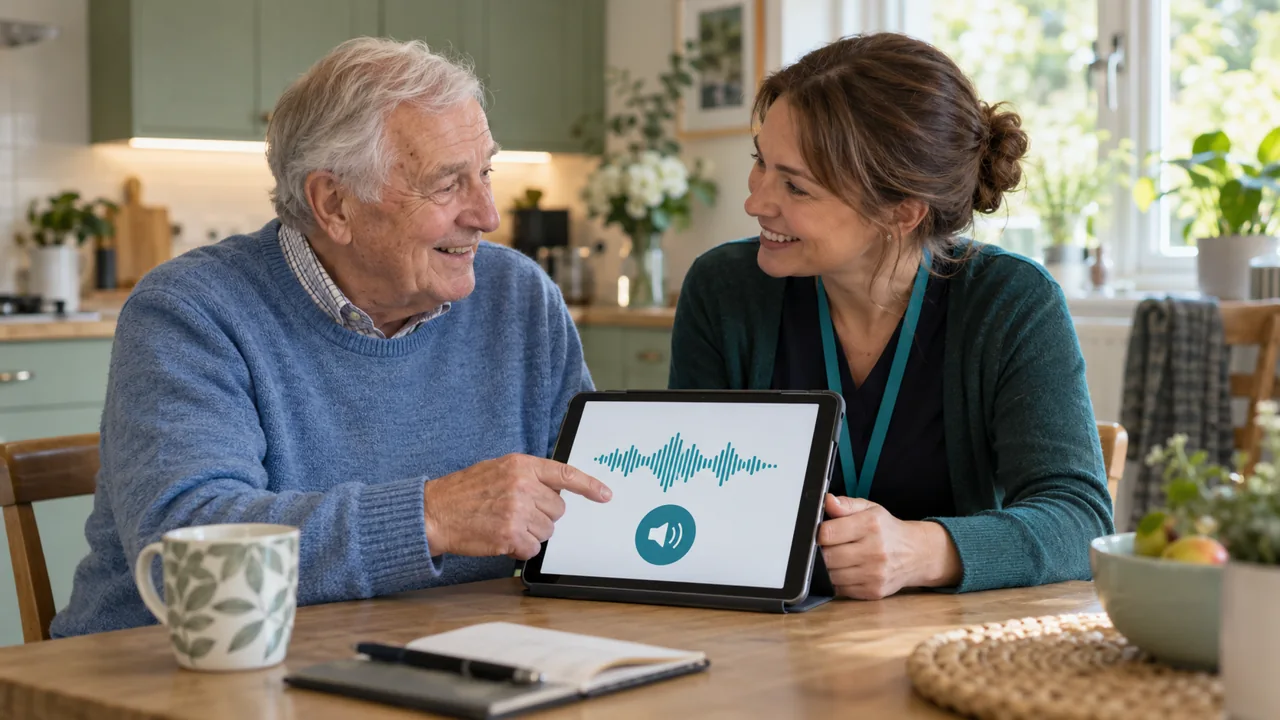
AI-generated illustrative scene. Not a real patient or a photograph of the people mentioned below.
A REAL-WORLD EXAMPLE
Baroness Jane Campbell: her words, her voice.
On 13 October 2026, Baroness Jane Campbell of Surbiton used an AI recreation of her voice to address the House of Lords. Living with spinal muscular atrophy, she has experienced increasing difficulty speaking. The technology voiced a speech she had written herself, allowing her to contribute in a familiar voice.
It is a powerful example of assistive technology supporting participation and independence. Healthbotics was not involved in this parliamentary example.
For an older person whose speech has become difficult or tiring, a familiar digital voice may support conversation. Changes should be assessed, rather than assumed to be an inevitable part of ageing.
02
After an accident or illness
A head injury, stroke or neurological condition can affect speech. Depending on the person's needs, a communication aid can provide another way to express a message.
03
Living with speech difficulties
Where speech becomes less clear or is lost, typed or selected words can be spoken by a personalised digital voice. A speech and language therapist can help assess the best approach.
How a personal digital voice is made
With the speaker's informed permission, suitable voice recordings are used to create a synthetic version of their voice. Recording while speech is relatively clear is often helpful; existing recordings may also be usable. The person then types or selects what they want their communication aid to say.
This creates new speech in a familiar voice. It does not repair the vocal cords, treat a neurological condition or automatically turn every unclear utterance into clear speech. Consent, control over recordings and support with the device matter.
LISTEN TO THE POSSIBILITIES
One voice. Two illustrative deliveries.
Illustrative AI-generated demonstration. Both clips use the same fictional British male voice. They are separately generated examples, not a real patient's before-and-after recording or a demonstration of clinically validated speech enhancement.
01 / ILLUSTRATIVE INPUT
Slower, effortful delivery
A digitally altered example with repeated syllables, a huskier sound and less distinct words. This is an illustration, not a recording of a particular speech disorder.
02 / ILLUSTRATIVE OUTPUT
Clear synthetic delivery
The same words in a clearer synthetic voice, illustrating the idea of personalised voice output.
Words spoken in both clips: “How are you today? Hope you are well. It's lovely to speak with you again. Thank you for taking the time to listen.”
Journals named on the original Healthbotics page. These are reading links, not claims of affiliation, endorsement or verified training-data provenance.
Open a journal to browse its articles and available full text. Access and PDF availability depend on the individual article and publisher. The original list does not identify specific journal papers.
Journal names are consolidated from the original AI Papers page; its duplicate NEJM entry is shown once. Archives of Internal Medicine is linked through JAMA Internal Medicine.